Promoting engagement and privacy in teen healthcare


Promoting engagement and privacy in teen healthcare
Preventive care visits offer a key opportunity to both address teens’ health needs and to help them become more engaged in their own healthcare. The C.S. Mott Children’s Hospital National Poll on Children’s Health asked a national sample of parents of teens age 13-17 about healthcare confidentiality for their teens age 13-17.
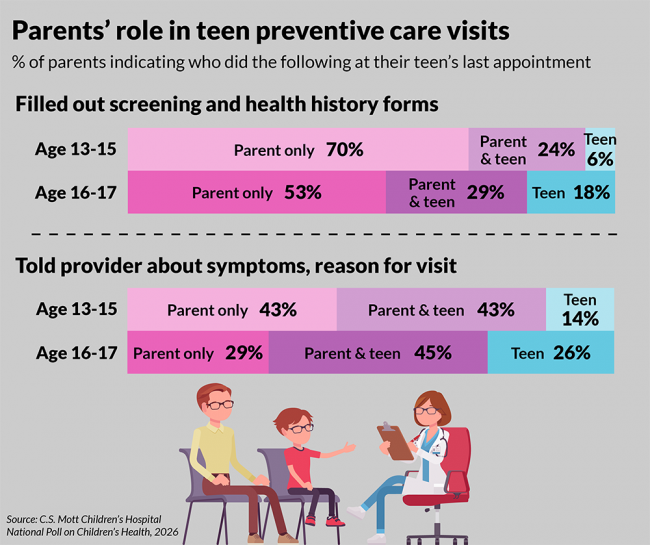
Of the 93% of parents reporting their teen had a check-up / preventive care visit in the past two years, most (91%) say they attended that visit along with their teen. In most cases parents who attended their teen’s most recent preventive care visit say they filled out screening and health history forms themselves (62%), while 12% say their teen filled out the forms and 26% recall doing it together. With regard to telling the provider about the reason for the visit and any health problems, 36% of parents say they did this themselves, 20% say their teen did this, and 44% say the teen and parent did this together. Parents are more likely to handle these actions themselves for younger (age 13-15) than older (age 16-17) teens.
Among parents who attended their teen’s most recent preventive care visit, only 35% say the provider talked privately with the teen, without the parent in the room. Parents are more likely to report private time with the provider for older than younger teens (41% vs 29%). Reasons for not having private time include the provider did not offer (62%), teen was not comfortable talking privately with the provider (26%), parent was not comfortable with their teen talking privately (11%), and unsure (14%).
Among all parents, only 21% recall healthcare providers talking with them about confidential services for adolescents, and only 11% recall discussion about limits on information that parents are allowed to see on their teen’s patient portal. Still, 66% say they understand the laws in their state related to confidential healthcare for teens.
While 68% of parents agree that it’s important for providers to talk privately with teens during healthcare visits, parents express concerns about healthcare privacy and confidentiality for teens, including the teen getting advice or treatment the parent doesn’t approve of (39%), that they want to know what their teen is up to (28%), and that it’s their job as a parent to monitor their teen’s healthcare (67%). Nearly all parents (92%) think they should have a right to see all of their teen’s medical records up to age 18.
Highlights
- 2 in 3 parents agree it’s important for providers to talk privately with teens during healthcare visits.
- Only 1 in 3 parents say their teen had private time with the provider at their last check-up.
- Only 1 in 5 parents recall healthcare providers talking with them about confidential services for teens.
- 9 in 10 parents think they should see all of their teen’s medical records up to age 18.
Implications
Preventive care visits (also called well-child visits) are an important time for healthcare providers to listen to concerns and questions about their patients’ health and to offer guidance on how to achieve healthy growth and development. When children are younger, most of the communication is with their parents, but as they become teens, preventive visits should pivot to increasingly involve the teen. Healthcare providers can do this by engaging the teen in the different aspects of the visit, including talking privately with the teen.
A teen-focused preventive visit can begin with engaging the teen in small but meaningful tasks, such as checking in for the appointment and completing health update and screening forms. This helps the teen feel comfortable at the clinic, improves their knowledge of their own health history, and gives them practice reporting their health status and symptoms. Findings from this Mott Poll suggest that many parents handle these tasks without involving their teen. While it is understandable that parents feel they can do these more efficiently and correctly, they are missing a “teachable moment” to help their child take the first steps toward being responsible for their own health and healthcare.
Parents also may not consider the possibility of decreasing the usefulness of the surveys and forms used at well visits. National recommendations call for screening teens for depression through a standardized form that asks about the teen’s emotions. Screening is intended to help providers identify concerns early and offer guidance or treatment when needed; however, screening is only effective if teens are able to provide honest information about their own experiences. When parents complete the screening form or monitor their teen’s answers, providers may not receive a fully accurate picture of the teen’s emotional wellbeing.
Adolescence is a time of physical, emotional, and social changes. Many teens have questions about puberty, mental health, reproductive health, or peer pressure. Private time between the teen and the healthcare provider – with the parent out of the room – is recommended to support honest communication during adolescent healthcare visits. These conversations allow teens to ask sensitive questions or discuss concerns they may feel uncomfortable raising in front of a parent. Private time also allows teens to get more comfortable talking with a healthcare provider and helps them learn how to describe their physical and emotional health.
In this Mott Poll, about two-thirds of parents agreed that private conversations are important. Despite this, only one-third of parents reported that private time occurred at their teen’s most recent preventive care visit, most often because the provider did not offer it. This suggests providers may be missing opportunities to normalize private conversations as a routine part of adolescent care that encourages teens to share concerns more openly.
State laws vary regarding minors’ ability to consent to certain reproductive health, mental health, or substance use services; in addition, some healthcare systems limit parent access to portions of the teen’s medical record to protect confidentiality. Many parents also expressed hesitance about healthcare confidentiality for their teen, including some who were concerned that they might not approve of the advice or treatment their teen receives. Few parents recalled the provider discussing confidential services for teens or limitations on what information parents can view through the teen’s patient portal. This lack of guidance is problematic; providers should explain to parents what the clinic’s confidentiality policies entail, including the reasons for those policies, and be prepared to address parents’ concerns. Clear communication from providers about these policies and their purpose may help families better navigate the balance between supporting their teen in becoming more responsible for their own health while maintaining appropriate parental involvement.
Data Source & Methods
This report presents findings from a nationally representative household survey conducted exclusively by Ipsos Public Affairs, LLC (Ipsos) for C.S. Mott Children’s Hospital. The survey was administered in February 2026 to a randomly selected, stratified group of adults who were parents of at least one child age 13-25 years living in their household (n=2,101). Adults were selected from Ipsos’s web-enabled KnowledgePanel® that closely resembles the U.S. population. The sample was subsequently weighted to reflect population figures from the Census Bureau. The survey completion rate was 69% among panel members contacted to participate. This report is based on responses from 1,169 parents with at least one child age 13-17. The margin of error for results presented in this report is ±2 to 5 percentage points.
Findings from the C.S. Mott Children’s Hospital National Poll on Children’s Health do not represent the opinions of the University of Michigan. The University of Michigan reserves all rights over this material.
Citation
Clark SJ, Gebremariam A, Schultz SL, Beel L, Woolford SJ. Promoting engagement and privacy in teen healthcare. C.S. Mott Children's Hospital National Poll on Children's Health, University of Michigan. Vol 49, Issue 3, May 2026. Available at: https://mottpoll.org/reports/promoting-engagement-and-privacy-teen-healthcare.